

Part 1, Town: On Morris Dancing, Mythago Wood, Arsenal’s Victory in the Premier League, The Visions of Isobel Gowdie and Cigarettes with Alan Davies
One morning, one morning, one morning in May, I spied... well, I spied merriment. Certainly, no fair ladies cold as clay. Some fair ladies a little worse for wear, sure, a long night of drinking is part of the fun for some, but none bore the pale caste of the grave. It was early morning in Oxford on the first of May. I’d been awake since five with my friend and her sister to go see their other sister dance with the Oxford Morris Side as part of the May Day festivities. At this time of year, the dawn is just breaking at that hour. When I took my dog, Sparrow, out into the garden before I left so he could do a radioactive piss (he’s on medication), I was reminded of a scene in Eric Rohmer’s Four Adventures of Reinette and Mirabelle in which ‘the blue hour’ is described: ‘not an hour, a minute really [...] the day birds aren’t up yet and the night birds are already asleep. Then... there’s a silence....’
Eric Rohmer, 1987, ‘Four Adventures of Reinette and Mirabelle’
Then Sparrow, the daft bastard, started barking at nothing and I put him back inside (nature abhors a vacuum after all). By the time I’m out the front door, the day birds are fully awake and hordes of revellers prance towards the high street in step with their song. Some are wearing flower crowns from Amazon, others are wearing ones hand woven from hawthorn sprigs. Hawthorn is the symbolic flower of May Day because supposably they used to be at the height of their blossom at the start of the month under the Julian calendar, but I’ve never noticed that thirteen days make much of difference. I hope they didn’t make those crowns inside, I thought to myself, as my mother taught me it’s bad luck to bring quickthorn into the house (hawthorn by another name, as in ‘the quick and the dead’). She taught me the same about snowdrops, because they grow in winter graveyards. Hawthorn smells like carcasses and pricks the skin deeply, but it’s still probably worse luck to buy an elasticated chain of microplastic blooms on Prime.
It was busy in town. All night party goers, hypnogogic early risers, tourists, accordionists, a hundred or so dancers and a man dressed up as a tree paraded through the city centre. One of them played a tune called Bonny Green, which disquieted me as I had just written a very long poem about Bonnie Blue the pornographic actress bedding a thousand druids at Stonehenge to bring about a new millennium of English Hell (see appendix A). What could this mean? Hawthorn, after all, is believed to mark the entrance to the otherworld in Gaelic mythology. I tried to reassure myself that we live in a secular age where symbolic resonances do not portend real life consequences.
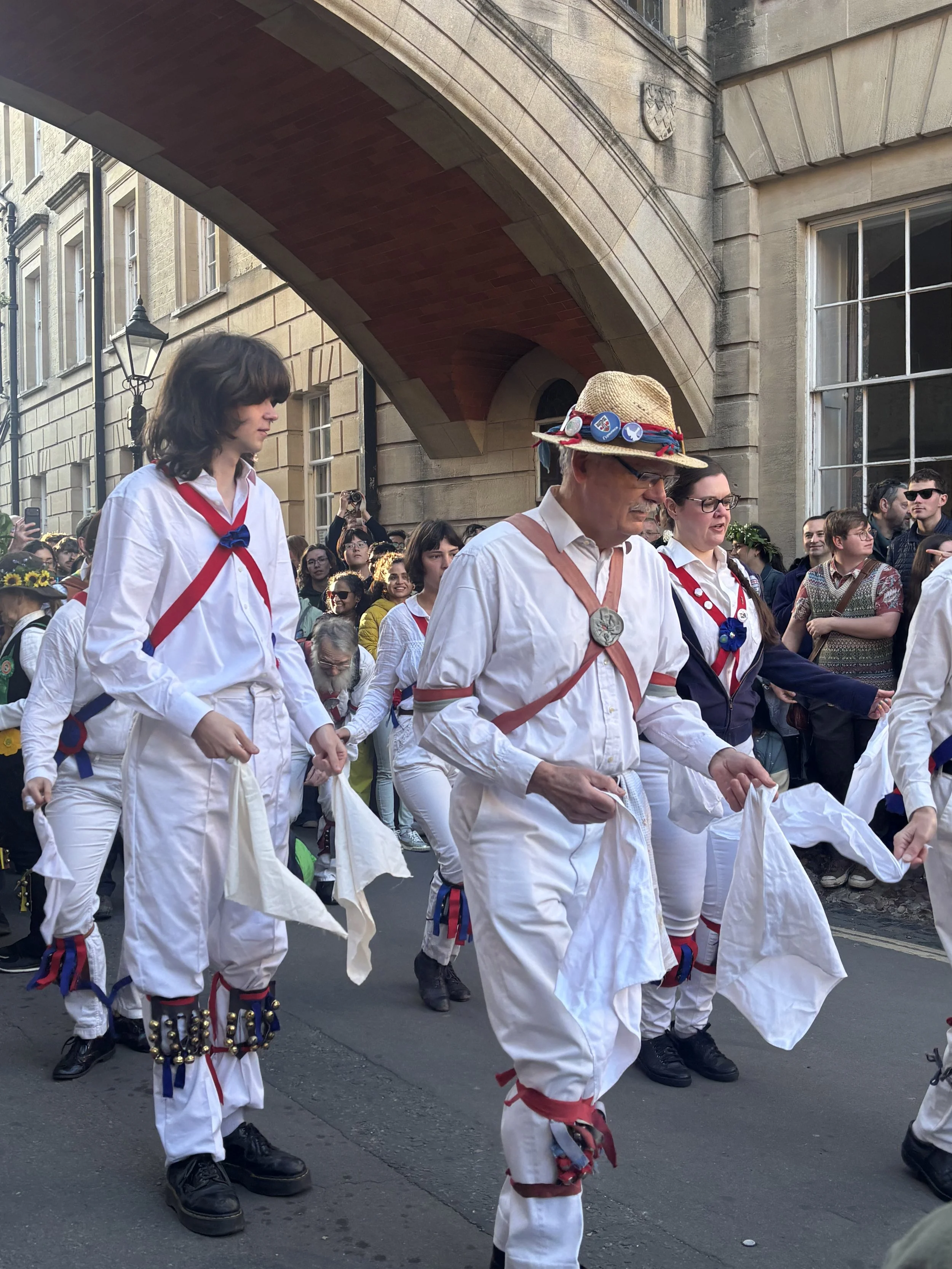
morris dancers on may morning
We went to go see the Oxford Morris Side dancing under the Bridge of Sighs. On the opposite side of the road, I watched a dense crowd filming it on their phones. The synchronised movements of these myriad devices were entrancing, like the coordinated leaps and turns of the dance itself (albeit more disquieting). So many glass eyes, shifting together like a fifth beast of Revelation beating its wings. In the Bible, the presence of a Man covered in eyes is part of the perfection of God’s prophecy, but on the streets of Oxford it is hard to feel the same. In fact, I did get out my own phone at one point and filmed Zoe dancing, and later disseminated that film on my Instagram story, and in doing this I did not feel like I was being led to a fountain of living water where the lamb of God wiped away my last tear (Revelation, 7:17).
On the pavement behind me, an old man and a young man conversed loudly. The young man was dressed in white, spoke with a Russophone accent and was struggling to come to terms with the quantity of alcohol he’d consumed over the hours prior. The old man was a jot more sober, and wearing the kind of outfit that, in a roundabout way, prompted me to invent the phrase ‘all trussed up like a peacock’s arse’. The wording here denotes some degree of sartorial extravagance, as the ‘peacock’s arse’ is famously where the bird grows its decorative plumage, but the use of the terms ‘all trussed up’ (hinting at the colloquialism ‘like a whore’s drawers) and ‘arse’ (home to the anus), lends the description a lightly pejorative feel. It is apt for a certain type of dress where eccentricity points to a conservative rather than radical temperament.
‘You know, I’ve never really seen what all the fuss is about Morris dancing,’ said the old man to his young companion, who made some vague noises in response. His voice reminded me of the television architecture critic Jonathan Meades: ‘The fact remains that it isn’t even pagan – the oldest examples are only four centuries old.’
Isn’t even pagan. The words cut through me like a knife.
Well, not really. He dampened my spirits a little because I was enjoying the dancing, and the simple fact of hearing that another person wasn’t temporarily lowered my mood. However, the disputation of the tradition’s supposed authenticity did little to rattle me. Unquestioning, unwavering continuity between past and present is not something I am drawn to, and yet I am still attracted to the old: to settings, activities, people and conditions that might be a-historically described as ‘pagan.’ In Lavondyss, the second book in the Mythago Wood cycle, author Robert Holdstock writes of British folk traditions like beacons – information witnessed at a distance, flashing across the landscape and across time, drawing in those who happen to be looking the right way. Nothing is static or dictated from above, nor is it necessarily ‘authentic’ in the sense that they exist in a fixed way outside of the eye of the beholder. Myths are created by their observers who become their participants. After looping back from a fearsome journey to the sublime heart of mythical Ryehope Wood, protagonist Tallis Keeton recalls the celebrations she attended as a child:
“She flew back through her imagination to the festival at Shadoxhurst, to the dancers, the nonsense words they often chanted as they went through their formations.
Jiggery, higgery, hoggery, joggery...
‘The land remembers,’ she whispered. ‘Men dance and chant, they fight with sticks, and one rides among them on a hobbyhorse, striking them with a bladder filled with pebbles... we don’t forget...’
‘We just forget why,’ Wyn-rajathuk agreed. ‘There is no magic left in the festive practices of Oxford, or Grimley, or wherever – the Morrismen and Mummers – no magic unless the mind that enacts the festival has a gate opened to the First Forest’
That expression again. First Forest.”
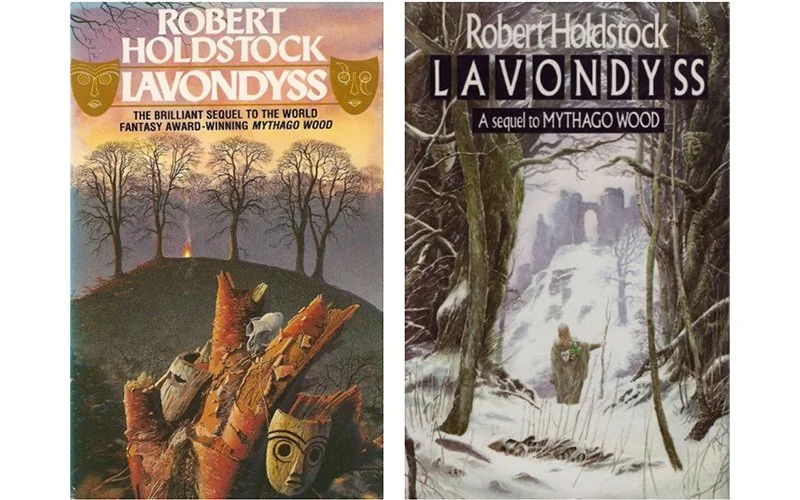
cover designs by Geoff Taylor
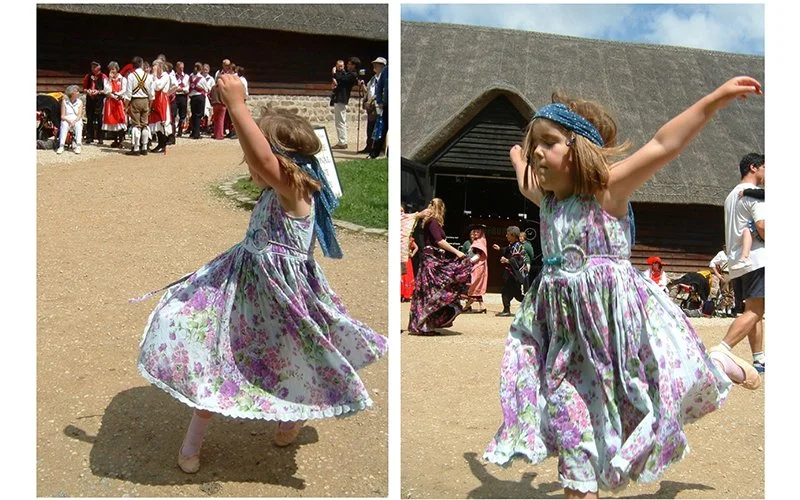
Me in Avebury in 2003, witnessing Morris dance for the first time then engaging in an experimental response, unconcerned with the supposed authority of tradition
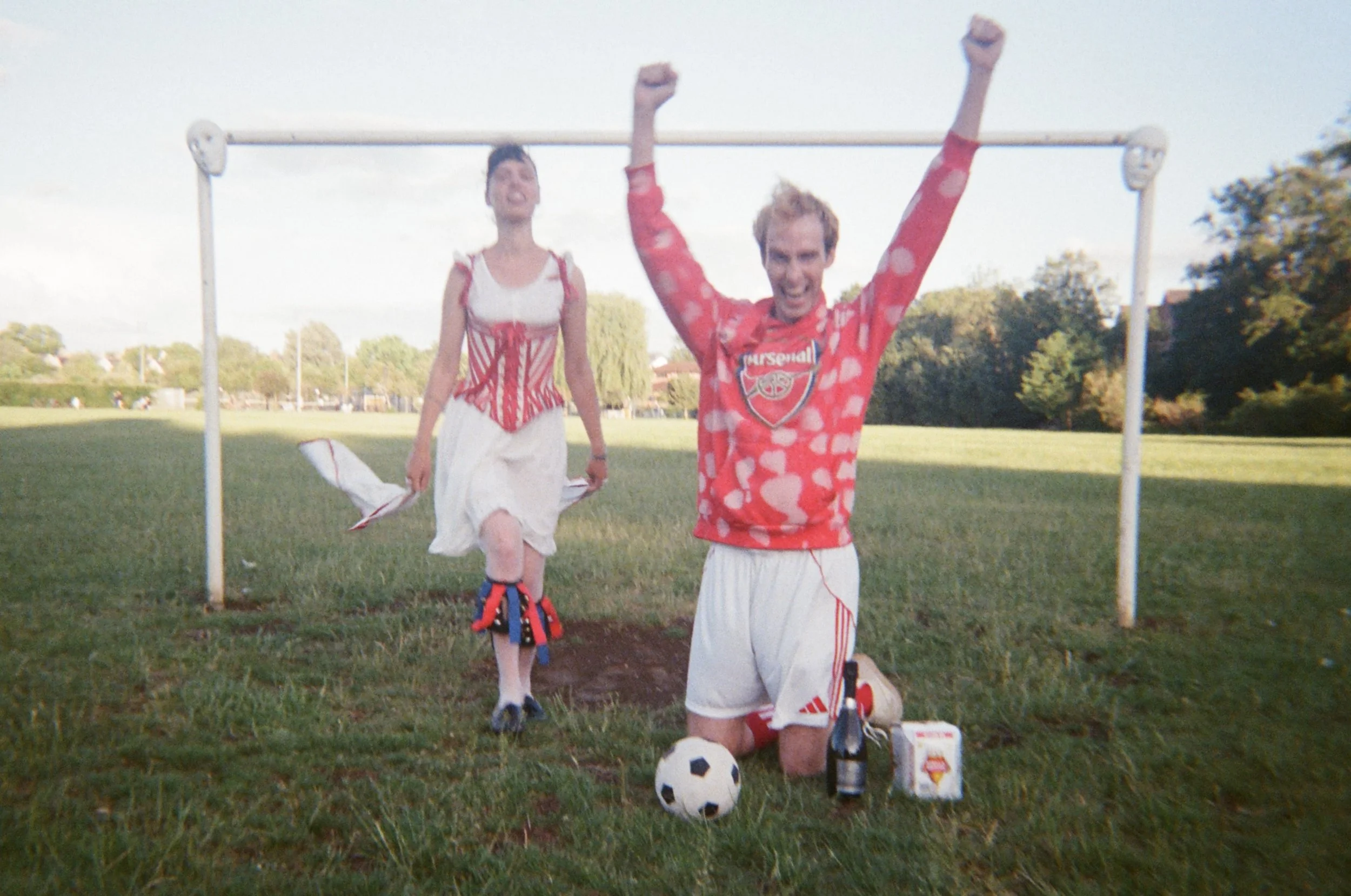
I was finishing this book during the third week of May, when Arsenal won the premier league. Now, I would say I care about football perhaps 20% more than the majority of my milieu (mostly unathletic, waifish, art school-types), but 1000% less than my boyfriend. When we used to live together in Crouch End and regularly took the Great Northern Line, he would stick out his tongue and pant like an ecstatic dog when the train passed by the Emirates Stadium. He assures me he was ‘doing a bit’, with ‘self-awareness’, but I’m not so sure. I was nominally an Arsenal fan before I met him, but this was really a result of my wanting to better understand and enjoy going to the pub after moving to the Holloway Road. However, the prospect of potentially seeing them win the league did rouse my interest, so on the evening of Tuesday the 19th I walked to my boyfriends’ friends’ house to watch Bournemouth vs Man City, the deciding game.
Football encourages magikal thinking - I promise you, some of the most normal men you know are engaging with reality in radically pre-modern ways. In The Visions of Isobel Gowdie, historian Emma Wilby discusses the discrepancy between pre-modern and modern patterns of belief as they relate to the disappearance of shamanic experience in Britain. She writes about the impossibility of us moderns conceiving of the inner workings of a mind which held true that ritual can have an objective impact on our fortunes and the fortunes of the people in our community, rather than just a personal, psychological palliative. What this fails to account for, however, is that I have met many people who believe that the clothes they chose to wear or the position they sit in a room while watching a game will affect the score. On the night of the 19th, my boyfriend’s Dad had to put on the Tottenham/Chelsea game instead because he believes Man City always win when he’s watching.
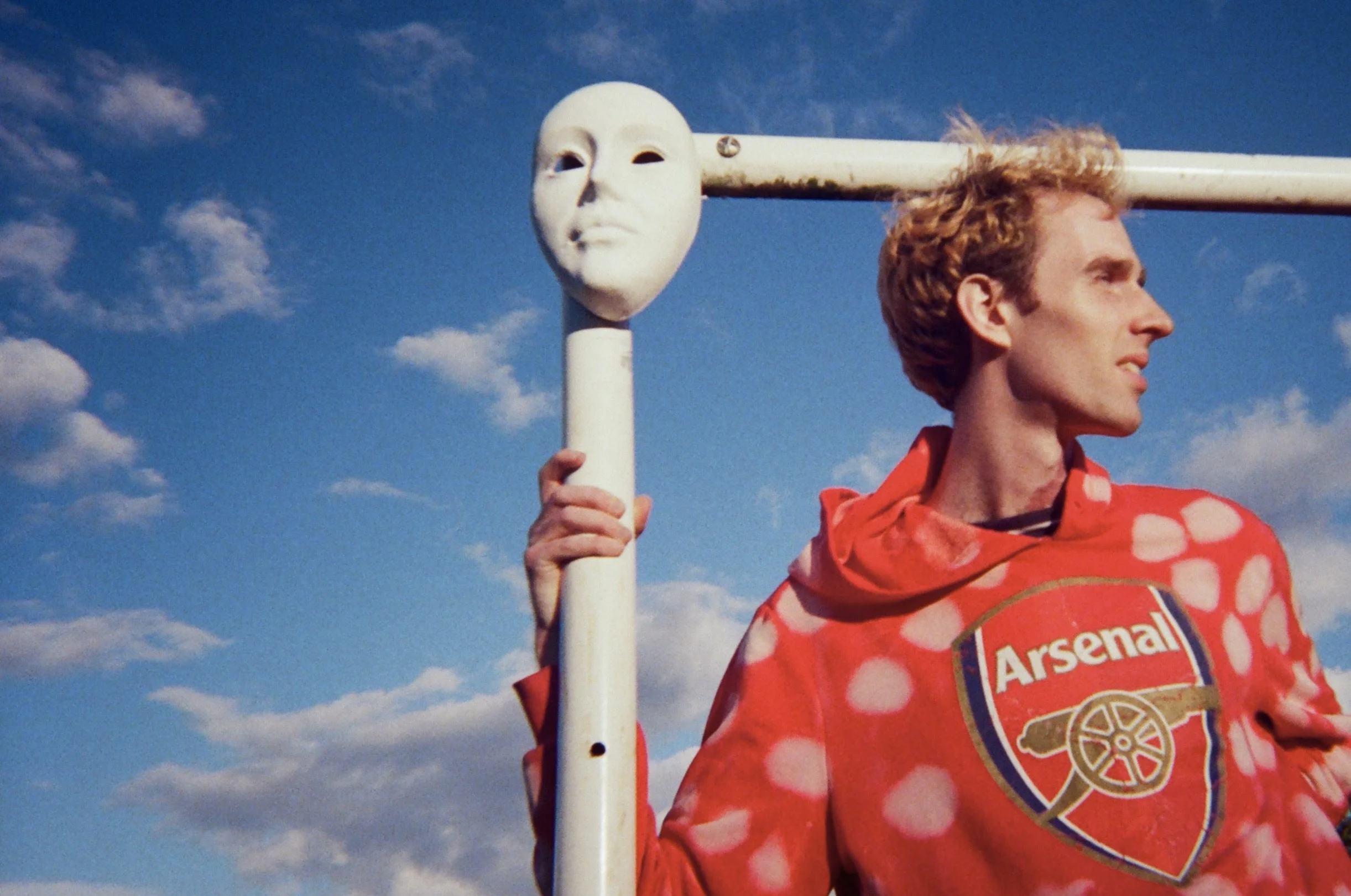
football shamanism
I heard afterwards that Mikel Arteta (Arsenal manager, for the unathletic art students amongst you), was too nervous to watch the game, so instead walked out into the night on his own to build a fire. Now, the papers posit this was a barbecue-style situation, but I chose to believe otherwise. For aeons, human beings have searched the endless chasm of night for flickers of insight, stars dashing across the firmament, smoke dancing in the shape of our ancestors. Is it possible that Arteta looked into the flames and the flames looked back?
... A man made of fire and ash burning through eternity to greet him at the final steps of the hero’s journey...
... he whispers ‘don’t look back Mikel, don’t make the same mistake I saw Orpheus make, don’t check the score...
...watch the stars Mikel, only the stars.’

Mikel Arteta and his barbecue (via ‘arsenal buzz’ on x)
Perhaps if the Old Ones had shown him where to look, he could have seen the result written in the heavens above North London (sport is broadcast on Sky, after all). Under the same North London heavens, we listened to the final whistle ring out like the shot heard around the world (/Finsbury Park). We darted out to the corner shop to buy prosecco like mad hares, moon drunk and shrieking. The music of car horns filled the air, and the streets were painted with red and white like the vessels of Christ’s blood and sweat Joseph of Arimathea brought to Glastonbury when he planted the holy hawthorn tree. Striped scarfs rippled out the windows of passing vehicles like ribbons on the may pole. The W5 pulled up and we worried that the driver might not let us on because of the open bottles of sparkling wine, but when the door slid open, he joined the horn chorus and beckoned us in:
“Come on you gunners!!” He called. “Don’t bother tapping in lads, this one’s on me!”
The interior of the bus, wouldn’t you know it, was also reminiscent of blood and sweat and the holy thorn: everyone was festooned in red and white, and strangers were gleefully engaging one another in conversation.
We’re all on the same team, and we’re all winning!
“Do you think this is how it felt to win the world wars one and two? Or do you think this is how Boudicca would have felt if the Iceni had successfully driven the Romans out of Britain? Or do you think this is how it feels to walk a dark path through the woods alone, knowing that the wolves are running at your back, but you shall not be taken by their savage jaws because you are walking under the sign of a divine protector? Do you think this what it feels like to be a success?” I asked my boyfriend.
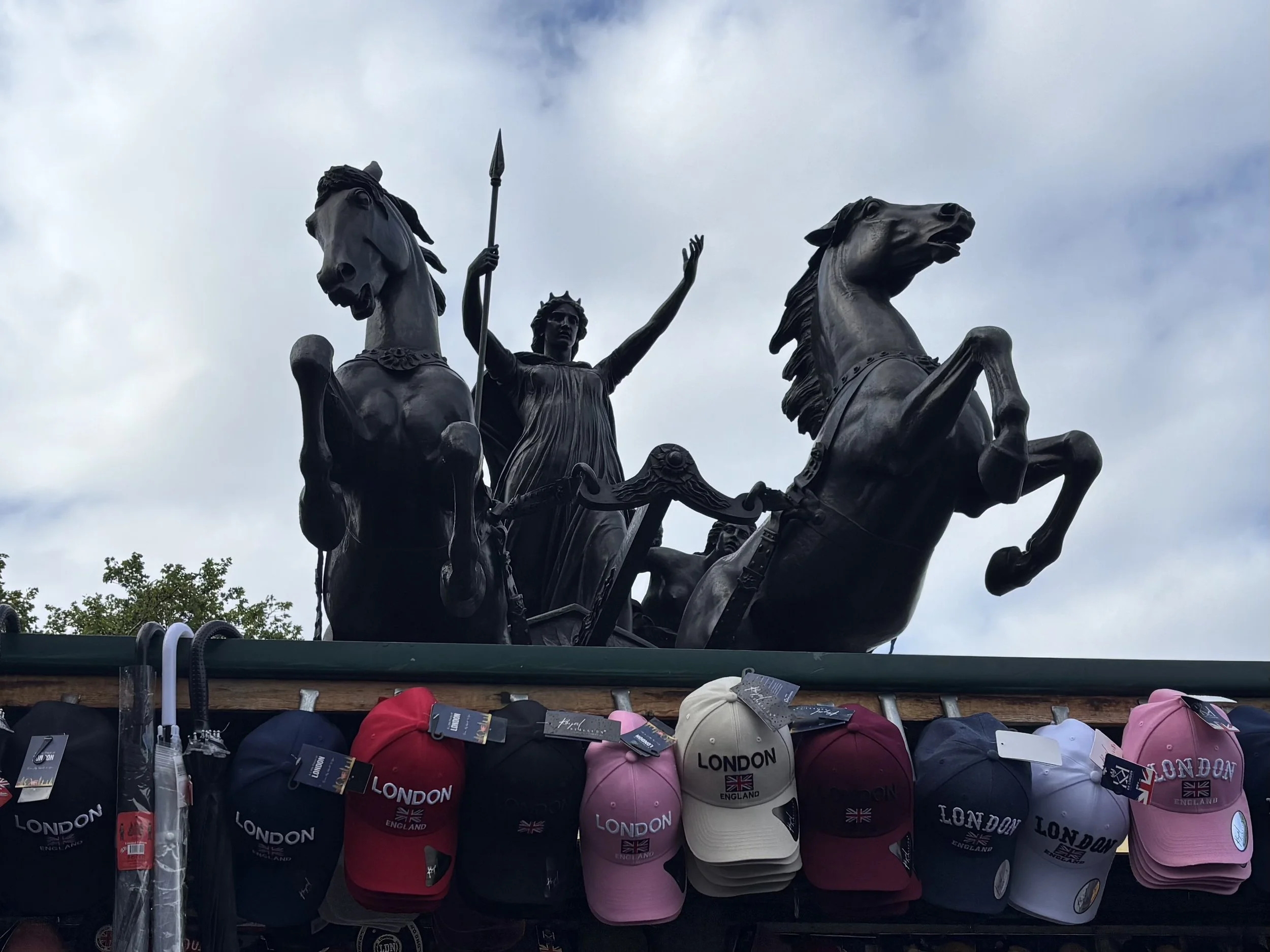
Boudicca and her Daughters by Thomas Thornycroft
“Probably,” he replied.
“And that’s just us, I wonder how the players feel?”
I do wonder how the players felt. At first, I found myself reaching for metaphors of war and conquest and victory, but the more I flickered through the possibilities of the colour red I struck upon Powell and Pressburger’s The Red Shoes. After all, professional football players do not wield guns on the pitch, but they do push themselves to physical and psychological extremes for their audience through acting out choreographed movements (albeit in an improvisational fashion). In The Bright Labyrinth: Sex, Death and Design in the Digital Regime, author Ken Hollings writes about how the evolution of ballet out of seventeenth century court dance in France describes a consciousness shift in its players. For the earlier dancers:
“The Rhythmic patterns [...] are an attempt to reflect the external workings of the world as a harmonious whole. The precursor to classical ballet, court dance is based on prearranged sets of movements that are copied by each of the participants, either together or in sequence, allowing them to see their every pose and gesture precisely repeated by the dancers around them. Costumes and music, scenery and masks are also used to enhance the reassuring impression of being an intimately connected part of a smoothly operating universe; some dances even echo the harmonious motion of stars and planets above. In an age when representation is still predominantly allegorical, and mirrors remain little more than handheld appeals to vanity, court dance permits individual performers to see reflections of themselves within the carefully choreographed workings of the entire ensemble. They can, in short, examine their presence as part of an integrated outside whole.” (Hollings, 2014, p 70)
By the time of industrialisation, a different picture emerges:
“In 1895 at the Maryiinsky Theatre in the Imperial city of St Petersburg a revised version of Tchaikovsky’s ballet Swan Lake is presented to the public for the first time. Choreographed by Marius Petipa and Lev Ivanov, one of its highlights is the ‘Entrance of the Swans’ in Act II, which requires all twenty four members of the female corps de ballet to file out onto the stage in one long line that continually folds back upon itself. Executing a precisely repeated series of steps, each individual dancer copies the movements of those around her until every gesture has become duplicated, restated, superimposed. The edect is comparable to peering through the slots of a zoetrope, a piece of Victorian parlour magic.” (Hollings, 2014, p 67)
He goes on to say the dancers on the latter stage experience the production in a manner alien to the first troupe. The twenty-four swans exist as cogs in an automaton designed for the delight of the audience – not a mutual contemplation of their position in the divine order. In terms of their material conditions, footballers’ lives have more in common with the nobles of the French court (the ballet dancers would have received meagre wages for their part in the machine), but through the increasing integration of screens into their professional and personal lives they have a greater kinship with moving images than with allegory.
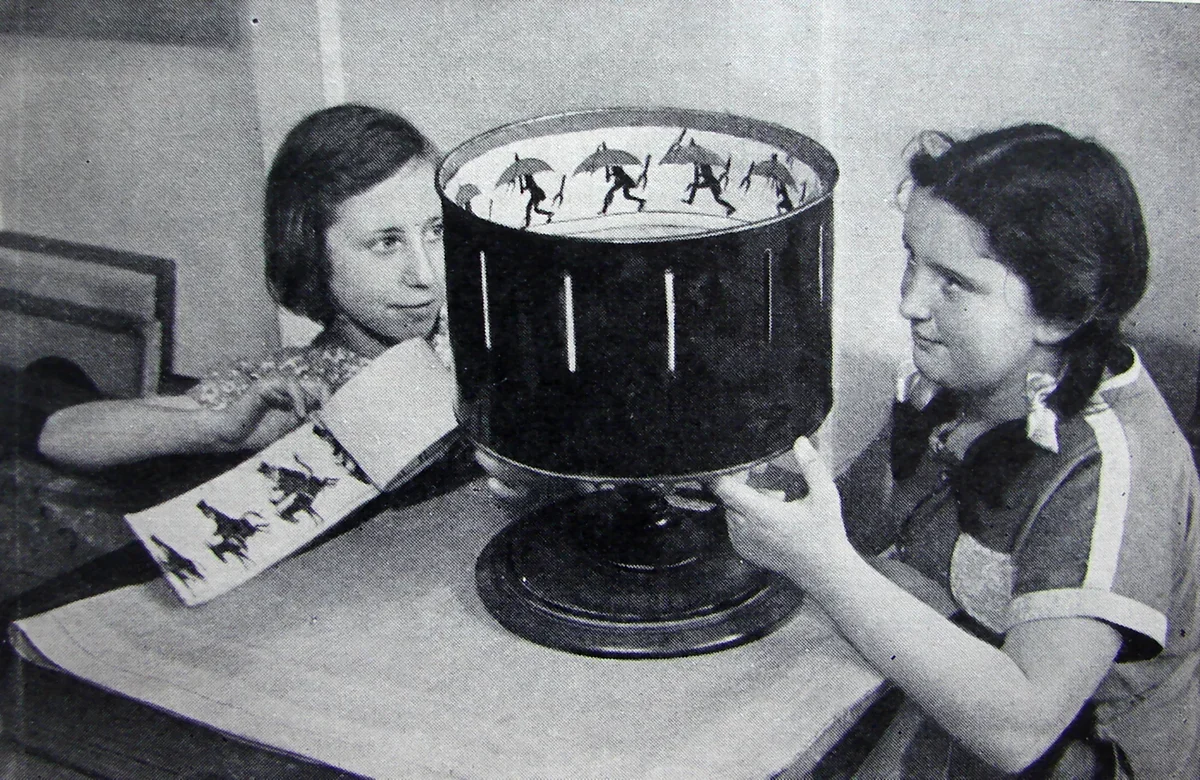
a zoetrope (via colin ward on alamy stock photos)
The first live football match to be televised in Britain by the BBC was a specially arranged friendly between Arsenal and Arsenal reserves at Highbury Stadium in 1937 (they went on to be the champions of the premier league that season too). It is impossible to dance like no one’s watching under such conditions: in 1945, squad captain Eddie Hapgood released Football Ambassador, the first football autobiography. An ambassador is the highest-ranking diplomat sent from their home country into foreign lands to represent their interests, and although this title might at first seem an odd choice given that Hapgood complains that he had his arm twisted by British Diplomats into performing a nazi salute at a 1938 game in Berlin, it is also hints at how the mewling babe of televised football he encountered would grow up into the biblically accurate angel of contemporary techno-culture. Over the century, the increased digitalisation of football means that it is largely played in foreign lands: the football player can represent football on the television in the living room, the computer in the office or the computer in your pocket to far more people than could pack out a stadium. I wonder, if Hapgood were to come to present day captain Martin Ødegaard in a portentous dream, say, he appeared to him like the ghost of Hamlet’s father walking the ramparts of the old Highbury stadium, how much would these two men have in common? Would the greater divide in their experience come from acceleration of the role of screens in their jobs, or from the fact that only one of them had to face legal repercussions for going AWOL during World War Two to play in a North London Derby (legend).
In answering this question, I am put in mind again of Wilby’s writing on Isobel Gowdie, a cottar’s wife who was tried for Witchcraft in Auldern, Scotland during the seventeenth century. Gowdie’s four confessions are notable for their vast quantities of highly unusual material, combining both fairy and devil belief – she describes diverse experiences, such as having blood sucked by the cloven-toed fiend (and having sex with him afterwards), flying on a magic horse, visiting the queen of the fairies at her home in Downie Hill and shooting Elf arrows at passers-by. Wilby argues that such testimonies pose challenges to the modern mind, as it is difficult for us to rationalise why she would have delivered such a long and detailed confession of events which we could not conceive of having taken place. Of course, it is very possible that she encountered forms of coercion and even torture during their extraction, but this does not explain the idiosyncratic nature of the texts - many women suffered this treatment during the witch trials, but there are scant other examples of torture producing such strange prose (many did not even confess at all). Perhaps, she suggests, the most modern explanation we can come up with then is that she was a mentally ill woman with a natural flare for storytelling (even though there is little evidence to suggest she had mental health issues). This, however, fails to account for the wider culture of belief that Gowdie belonged to, and the socio-economic realities that engendered them.
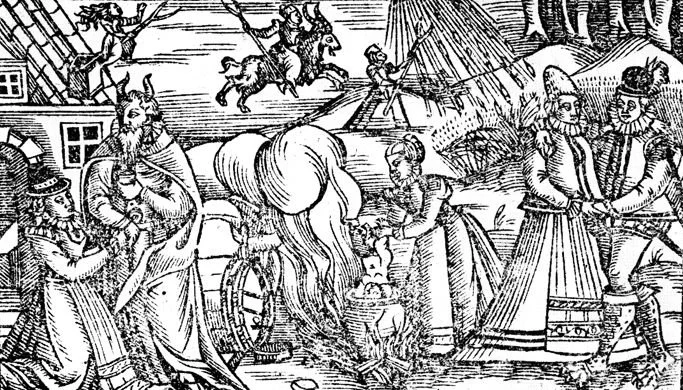
Illustration of witchcraft practices by Peter Binsfield in 1592. Although this predates Gowdie, Wilby notes that many of the acts depicted also occur in Gowdie's testimonies
Wilby invokes other accounts of visionary experiences in 17th century Scotland to illustrate how these beliefs existed outside the context of witch trials, describing how Perthshire cunning man John Gothray was seen by his fellow villagers as qualified to act as their doctor because of his experience being taken away by the fairies one harvest evening to meet his dead brother, who eventually decided to give him the gift of healing then returned him to the human world. When I look at an account like that and try to pick holes in it, my first thought is that this is a bit like all the white lies on my own CV – there is an incentive to exaggerate the truth in return for material advantages. Unfortunately, this doesn’t explain why such an account would produce that effect. After all, if my GP told me that they’d been to fairyland I would probably think that was awesome, but I don’t know if it would necessarily legitimise them in my eyes as a medic. That being said, I met a nice Irish couple in the smoking area during Arsenal’s Champions League final match against Paris Saint-Germain (boo) where we got to talking about contemporary Gaelic fairy belief. One of them said that her family believes that they were given a recipe for The Cure by fairies hundreds of years ago, essentially a magic medicine capable of healing any ailment. She told me that her great grandfather was facially disfigured in a factory fire, but after applying The Cure the burns vanished. She repeatedly insisted that her family believe this in a completely literal sense.
Wilby writes that in the history of academic writing about such visionary phenomena, terms such as ‘imagination’, ‘fantasy’ and ‘dream’ are the most employed descriptors. Only in recent years has a conversation begun about the shortcomings of this language, whilst at the same time the still controversial shamanic paradigm has gained more traction. She writes that one of the first writers to really engage with the experiential aspect of these visions was Norman Cohn, who wrote in 1971 that:
“It is clear that already in the Middle Ages some women believed themselves to wander about at night on cannibalistic errands, while others believed themselves to wander about on more benign errands, under the leadership of a supernatural queen. Later, after the great witch-hunt had begun, some women genuinely believed that they attended the sabbat and took part in its demonic orgies: not all the confessions, even at that time, are to be attributed to torture or the fear of torture.”
Wilby contends that one of the reasons that the reality of widespread visionary experiences feels so foreign to those living in post-enlightenment, post-industrial society, is that the living conditions of those experiencing them are equally alien. She writes that there is an established connection between asceticism and visions, and in 17th century Scotland the working classes were forced into a kind of involuntary asceticism. They would suffer chronic malnourishment due to food shortages, irregular sleeping patterns and every day they would perform labour that would push them to their physical breaking point. They would also suffer intense psychological stress, since they would be exposed to levels of sickness and death in their immediate communities (particularly among children) which we in the modern West are unlikely to experience. It is in this context that we can understand how spiritual practices such as dream interpretation, which today we often view as a vehicle for personal, psychological growth, were instead matters of survival.
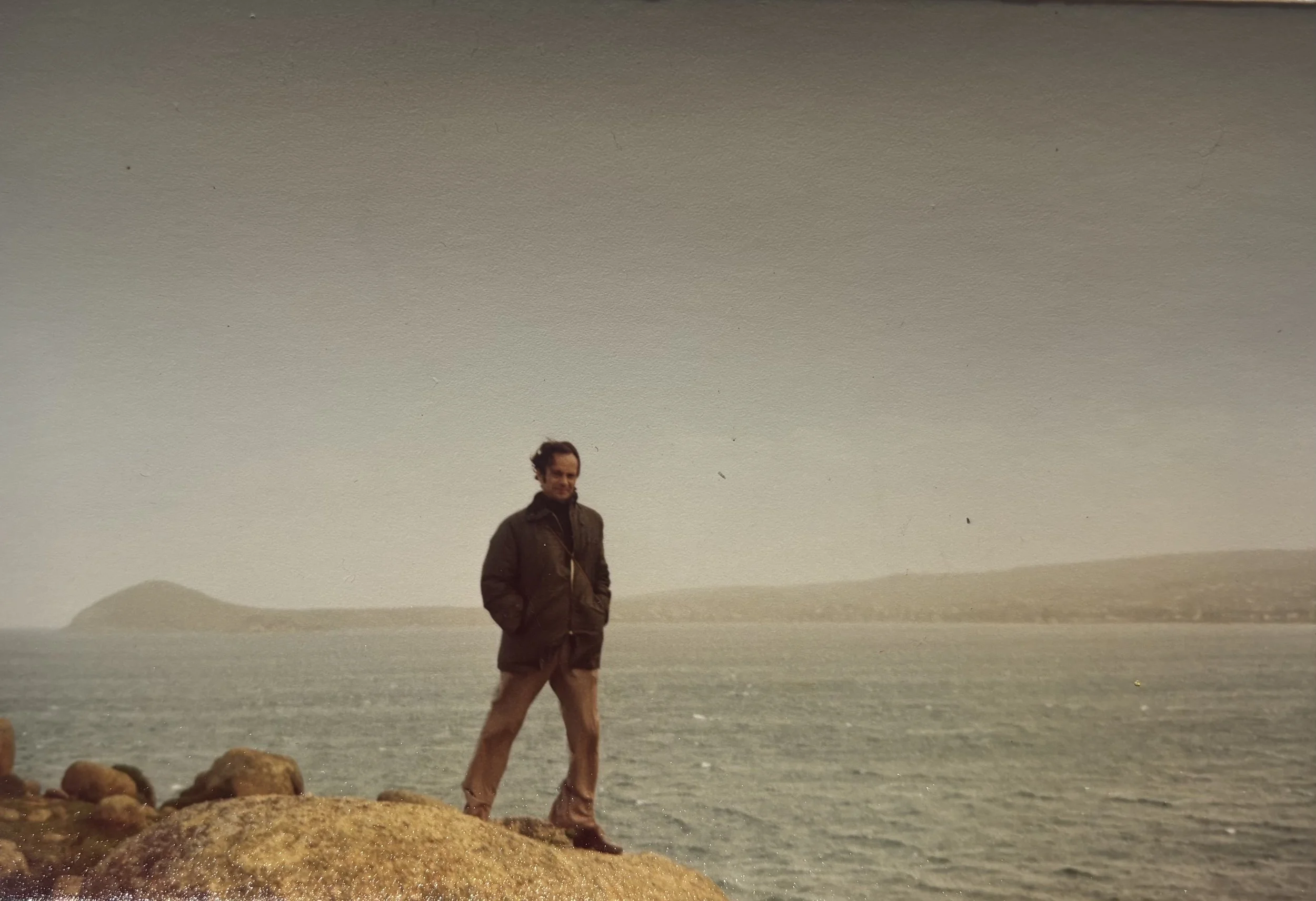
photo of Bill Hollis, my grandfather
The only member of my family whose death I remember was my paternal grandfather, Bill Hollis. It was during my first year at university, and my mum called me up as I was walking back from Sainsbury’s to break the news. My Grandfather was very old and had been ill for a long time, so as death’s in the family go it wasn’t too psychologically disturbing. Still, it stirred something in me, and a cloud of strangeness seemed to hover around for the rest of the day. That night, I awoke in the early hours of the morning, desperate for a piss. My accommodation had ensuite bathrooms, and the toilet was directly behind my bed board, so it would not have taken more than a few paces to get up and alleviate myself. However, a voice in my head which felt fractured off from my regular internal monologue commanded me: Don’t go to the bathroom, Holly. Bill’s ghost is in the bathroom. I did not go the bathroom, which, if you know me well, you’ll know was a real feat of physical endurance because I have a tiny bladder. Wilby discusses how, in many pre-modern cultures, to have a vision of a dead relative (either awake or in a dream), was not to encounter a representation of that person, but rather to meet with them when they journey here from the otherworld. In some groups, it was important to carefully report these meetings to a senior member of the community as the behaviour of the dead can affect the living and may need to be offset by ritual. In dire cases, if the dead reach out and touch you, it means you are marked to join them soon. Is it possible for me to believe that the reason I didn’t go to the loo that night was because I knew I might have accidentally bumped into my dead grandfather and thus sealed my own fate? Realistically, I’m probably not capable of believing that... and yet, I still wasn’t rational enough to go piss. I suppose, though, I am still principally modern in the sense that I told this experience to some friends as a joke, but I didn’t share it with a trusted member of my village to make sure the vision didn’t bring disaster upon myself or the people around me. I did, however, tell my dad about my meeting with his father, and he replied that in his twenties he had a strange dream that he was stood by the road hitchhiking. Only one car came past, which he realised was his father’s Rolls Royce, but he didn’t recognise my dad and drove straight past. My dad awoke to his phone ringing. He picked it up and heard his godmother on the other end of line cry out, ‘Adam, your father’s had a heart attack, and it's all your fault,’ (apparently his hippie-ish lifestyle was causing his father a lot of stress, so maybe this accusation was a call to redress this through ritual?)
Another example Wilby uses to illustrate the modern/pre-modern divide, is that of a child’s nightmare: if the modern parent is woken in the night by their child who has been frightened by a dream, they reassure them that the dream isn’t real and encourage them to go back to bed. If the same situation happens to the pre-modern parent, they might ask the child to recount the dream in detail, possibly bringing in the assistance of a local holy man. Growing up in an environment that reinforces the idea that your fantasies are materially real, seems certain to produce an experience of reality far diderent than if you’d grown up being assured the opposite . Whilst contemplating this I couldn’t help but think of Max Dowman, a winger for Arsenal’s current squad. Max Dowman is only 16 years old and has been juggling taking his GCSE’s with playing in the Premier League. Now, when I was doing my GCSE’s, an example of the sort of thing I fantasised about was ‘what if Spike from Buffy the Vampire Slayer was my boyfriend.’ How far off is this from ‘what if I was a professional footballer taking my team to victory in the Premier League?’ If a fictional vampire had come to life and asked me out on a date, I probably would have developed a consciousness closer to that of Isobel Gowdie than the one I possess currently. How might we plot Dowman on this spectrum? At a very early age, not only has he experienced the reality shift of the fulfilment of a dream so outside the experience of almost any other human being, in doing this he has also developed a relationship with screen technology that few of us can claim (if the advent of screen culture can be said to have fundamentally shifted the average person’s perception of the self, how diderent might the effect be if you are the spectacle rather than the audience?).

Max Dowman via arsenal.com
After an hour or so of drunkenly smiling at the Emirates Stadium with thousands of other fans, my boyfriend, his friends and I decided to go to the pub. We tried for The Enkel Arms, an old favourite meat-under-the-coat type spot off the Holloway Road, but it was shut so we went to Cousins Snooker Club around the corner instead. I am fond of this snooker club, partly because of the maximalist/absurdist approach to interior design: hand painted emojis decorate the ceiling above a framed photo of Princess Diana playing pool, portraits of Jeremy Corbyn sit alongside portraits of the Queen, a very glamourous image of a woman warns you not to do cocaine in the bathroom and there are live birds in the back. My boyfriend took me here on some of our first dates, which was when we dubbed the Cousins balcony (lots of statues of the Buddha, great view of the Emirates) ‘the most romantic place in London.’ I joked earlier that evening that it may also be the most psychedelic place in London – little did I know how prophetic these words would prove.
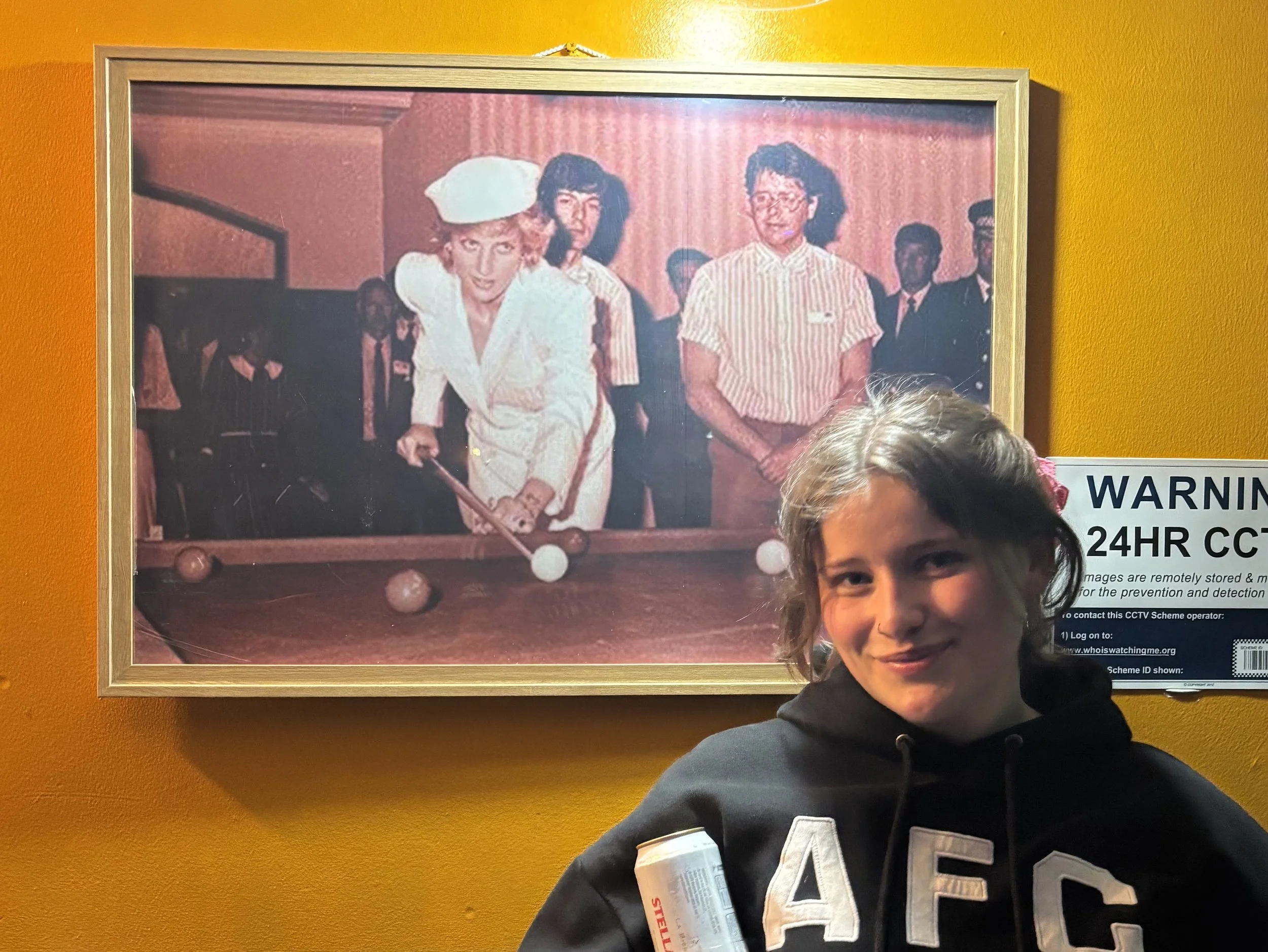
Lady Di the pool shark
It was virtually empty inside the pool room but when I went outside, I saw a group of three in the corner, and decided to go introduce myself because I like talking to strangers when I’m drunk. As we started to make chit chat about the game, I noticed a familiar voice amongst them: was I tripping or was the man to my left Alan Davies, the guy from QI and Jonathan Creek, a detective show about an autistic magician who lives in a windmill and wears a duffel coat and uses his knowledge of close up magic to solve crime?
“Are you that autistic magician who lives in a windmill and wears a duffel coat and uses his knowledge of close up magic to solve crime?”
“No, he was a fictional character, but yes I did play him,” replied Alan Davies.
“That’s crazy, you know, the funniest thing happened to me a few years ago, my friend and I decided to go to this sex shop in Soho to look for costumes for a party, but when we walked in there was this sort of, atrium room that was totally empty except for a red bookshelf with nothing on it except a box set of Jonathan Creek. Isn’t that strange?”
“Not really, I’m sure that sort of thing happens all the time,” he quipped.

Jonathan Creek
“Well anyway, Jonathan, let’s say, uh... they find a dead body in the Armoury, and they’ve been shot, and the room is locked from the inside... but there’s no gun – how would you find the murderer?”
“I wouldn’t know, as I said Jonathan Creek is a fictional character.”
“No you’re totally right, it’s just, have you ever read Mythago Wood?” Alan shook his head. “Well basically it’s about these two brothers whose father has vanished into these woods at the edge of their house, and they realise he’s discovered that the woods produce these myth creatures (‘mythagos’) from the minds of people who come close to the wood, but it’s not simple because the story creatures you or I might produce might also pull us into their world. In the sequel, Lavondyss, there’s a fire burning in bird spirit land because the original deed of the first myth is disrupted, and she has to go through the hollowing in the castle at the heart of the wood as a living holly tree to burn herself then return to find the shaman and the bone eater and die. Are you following me?”
“I feel like you’re veering towards mistaking me for fiction again?”
“Well, basically yes, I suppose earlier when I was down at the Emirates I had this vision of being in this living wood because everyone had climbed up into the trees around the stadium, and all these fireworks were sparkling above us and it just felt like... the old magic is still strong here. I actually messaged my brother earlier trying to get him to come down here saying:
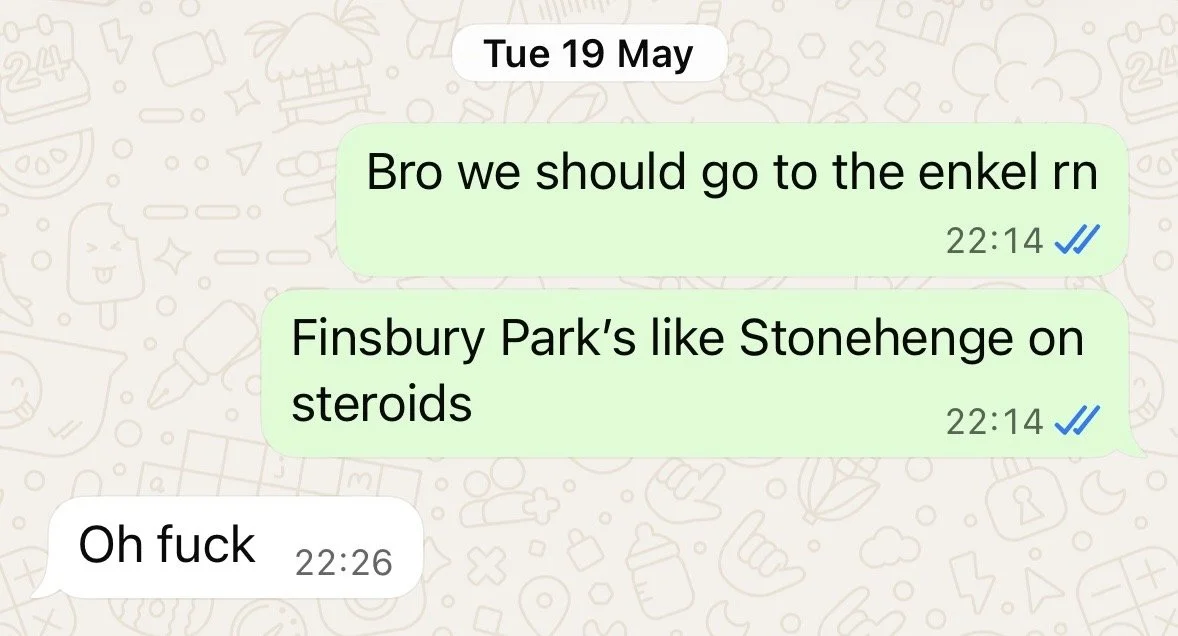
texts with Joey
Why did I invoke Stonehenge, Alan? Because the old magic is still strong here, that’s why! And if the magic is strong then maybe you have come to me via the television from the forest of dreams... Are you my Mythago, Alan?”
“No Holly, I’m real.”
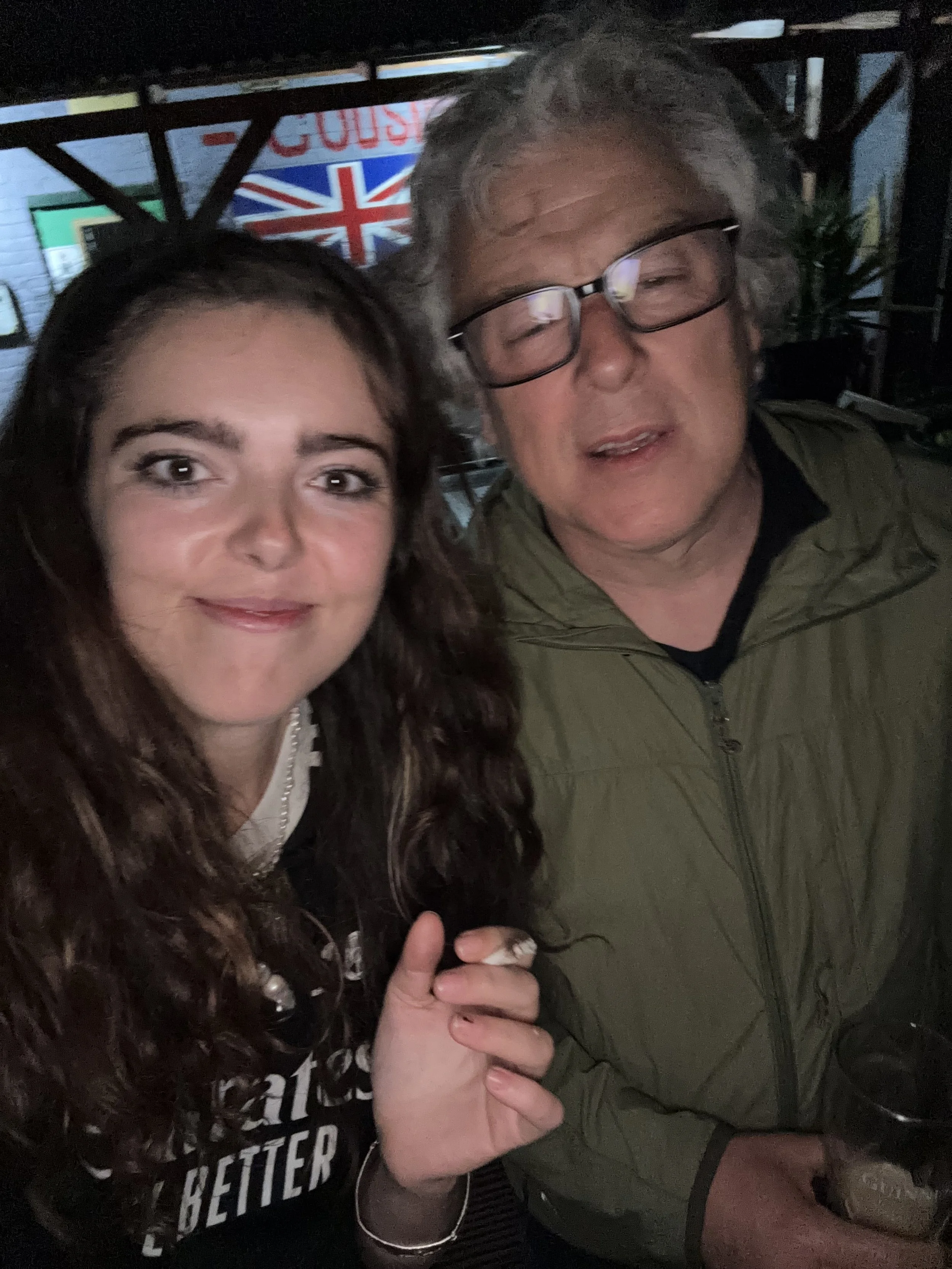
selfie with Alan Davies
End of Part 1. I will be posting ‘Part 2, Country: A dialogue with Worzel Gummidge (Acid Casualty) – On Crop Circles, Disruptive Traces and Meeting Amelia at the Foot of Milk Hill’ soon!
